

 Roteh Tours
When people think about tourism in Cambodia, they often think about temples, beaches, cities, and famous attractions.
But there is another Cambodia that doesn't need to be built.
It is already there.
It is the farmer working in the field early in the morning.
It is the garden beside a family home.
It is seasonal fruit hanging from a tree.
It is rice being harvested.
It is a traditional recipe prepared in a local kitchen.
It is a family sitting together around a table.
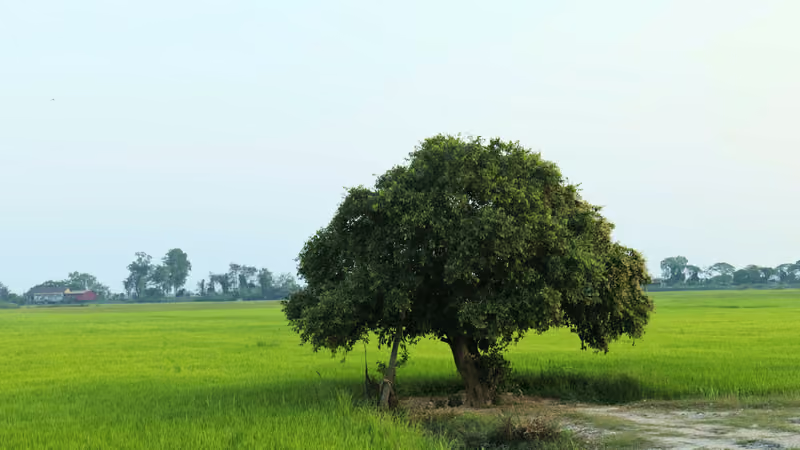
It is a village surrounded by nature.
This is where we believe the future of authentic agritourism in Cambodia can begin.
At Roteh Tours, we don't want to create a version of village life just for tourists.
We want travelers to experience the village life that already exists.
Agritourism is often described simply as tourism connected to farms and agriculture.
But for us, it is much more than visiting a farm.
Authentic agritourism means allowing travelers to understand the relationship between people, agriculture, food, land, and everyday life.
A traveler might walk through a real farm.
Meet the farmer who works there.
Learn about a seasonal crop.
Harvest what is naturally ready.
Bring it back to a local home.
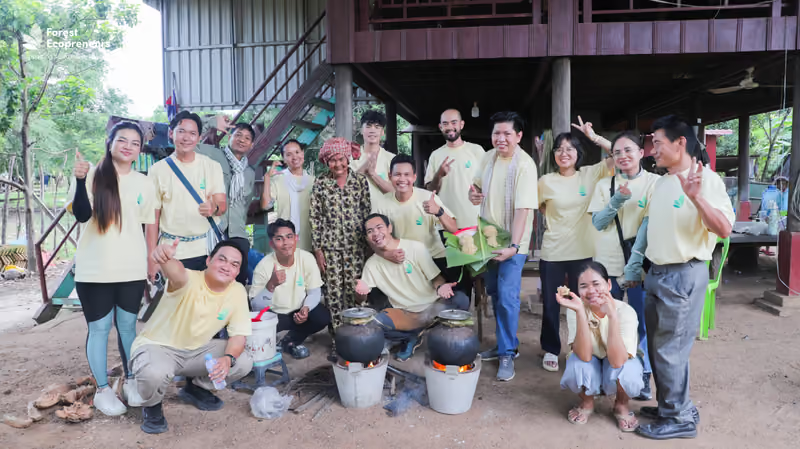
Prepare it with a family.
Eat it together.
Then stay overnight in the same community.
The experience does not need to be designed from scratch.
The community already has the experience.
Tourism simply creates a respectful way to share it.
Agriculture is deeply connected to Cambodian life, particularly in rural communities.
It influences food, livelihoods, traditions, landscapes, and the rhythm of everyday life.
This creates an opportunity for tourism to support communities without asking them to completely change who they are.
Instead of building another attraction, tourism can help create value from things communities already have:
Agricultural knowledge
Seasonal crops
Local food
Family recipes
Traditional skills
Natural landscapes
Community stories
Homestays
Everyday village life
This is important because authenticity cannot be manufactured easily.
A tourist attraction can be built.
But generations of agricultural knowledge cannot be recreated overnight.
A traditional recipe cannot be replaced by a demonstration.
And a real community cannot be replicated.
This is one of the reasons we believe Kampong Thom has strong potential for agritourism.
The province offers a combination of rural communities, agricultural landscapes, nature, local food, and important cultural heritage.
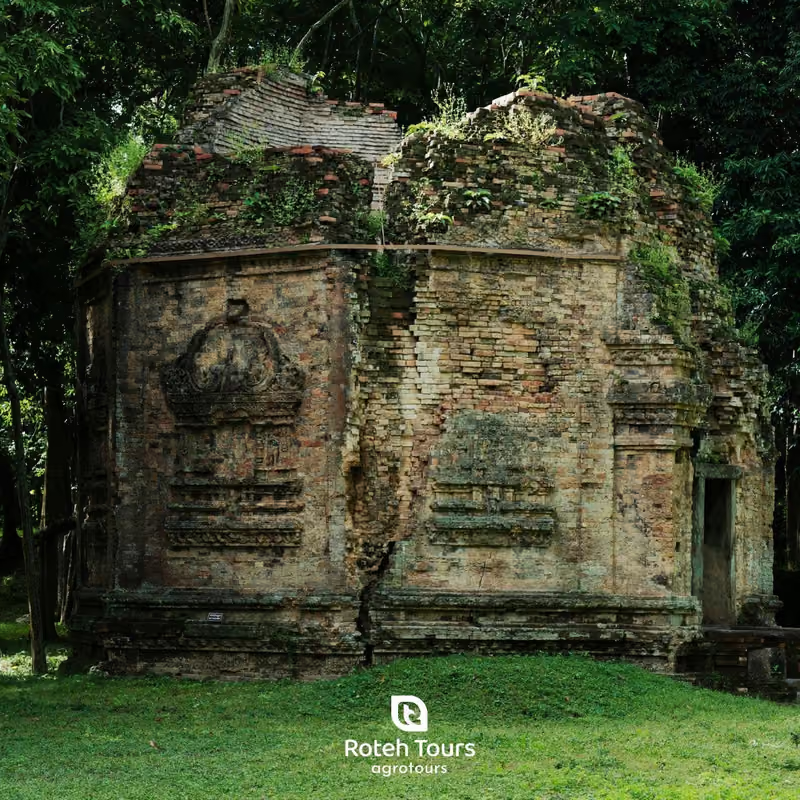
At the heart of the province is Sambor Prei Kuk, the ancient city of Ishanapura and a UNESCO World Heritage Site.
But Kampong Thom is not only about the temples.
Beyond the heritage site are villages, farms, homes, local producers, and everyday community life.
This creates an opportunity to connect two very different parts of Cambodia:
Ancient heritage and living rural culture.
A traveler can explore a temple that is more than a thousand years old and later sit with a local family sharing food.
They can walk through ancient forest and then discover how people cultivate the land around the community.
They can learn about Cambodia's past while experiencing how people live today.
That combination is what makes Kampong Thom special.
Modern travel often encourages us to move quickly.
See one destination.
Take a photograph.
Move to the next.
But some places become more meaningful when you stop.
Kampong Thom is a place where we believe travelers should slow down.
Slow down enough to talk to a farmer.
Slow down enough to understand a crop.
Slow down enough to notice what grows around a home.
Slow down enough to share a meal.
Slow down enough to sit with a host family in the evening.
And slow down enough to realize that the destination is not only the attraction listed on a map.
The destination is the life surrounding it.
This is where our Farm to Home concept comes in.
We see the journey as:
Farm → Harvest → Home → Kitchen → Table → Homestay → Community
It begins with the land.
A traveler discovers what is growing.
They meet the person who grows it.
They experience the harvest.
The ingredients return to a local home.
The family prepares them.
The food is shared.
And the traveler stays within the community.
For the family, this may simply be everyday life.
For the traveler, it becomes a way to understand Cambodia from the inside.
The food has meaning because you have followed its journey.
This is perhaps the most important part of our approach.
We don't want local people to perform their lives for visitors.
We don't want to create an artificial village where everything happens only when tourists arrive.
We don't want to turn everyday life into a show.
Instead, we want to create experiences where travelers can participate respectfully in what is already happening.
If farmers are harvesting, we learn about harvesting.
If a family is preparing food, we learn from the family.
If a seasonal ingredient is available, we experience that ingredient.
If nothing special is happening that day, we accept that too.
Because real life doesn't follow a tourism schedule.
And that is exactly what makes it authentic.
With Roteh Tours, an agritourism experience in Kampong Thom can bring together:
Discover seasonal crops and learn directly from local producers.
Experience where local food begins and how it changes with the seasons.
Walk through the community and understand how families live and work.
Learn how locally available ingredients become traditional dishes or baked foods.
Follow ingredients from the field to the family kitchen and table.
Stay and explore within a rural landscape surrounded by trees, farms, and countryside.
Meet the people whose knowledge and daily lives make the destination meaningful.
Stay with local hosts and experience a slower rhythm of Cambodian life.
These aren't separate attractions.
Together, they tell one story.
Roteh Tours was created from a belief that tourism can create value for both travelers and communities.
We don't want to bring travelers into communities simply to sell a tour.
We want to create opportunities for people to share what they already know and what they already have.
A farmer has knowledge.
A family has a recipe.
A village has stories.
A community has a landscape.
A producer has a product.
Tourism can connect those things with people who genuinely want to learn.
That is the kind of business we want to build.
For us, Travel With Impact is not just a slogan.
It is a way of thinking about tourism.
We believe a meaningful journey should leave something behind—not only memories for the traveler, but also value for the people and places visited.
When travelers choose a local homestay, eat locally produced food, learn from farmers, purchase from local producers, and spend time in a community, their journey can contribute to the local economy.
At the same time, travelers gain something that cannot be bought in a conventional attraction:
a genuine connection to place.
Perhaps Cambodia's next great tourism experiences don't need to be built.
Perhaps we simply need to look more closely at what already exists.
A farm.
A harvest.
A home.
A kitchen.
A family.
A village.
A landscape.
A story.
This is the Cambodia we want travelers to discover.
Not Cambodia recreated for tourists.
Cambodia as it really is.
And in Kampong Thom, we believe there is an opportunity to turn these authentic elements into meaningful agritourism experiences—while keeping the community, not tourism, at the center.
Come slowly. Eat locally. Learn from the land. Meet the people.
 Roteh Tours
 Roteh Tours